The Neuron (Uninitiated Series)
The Humble Beginning: McCulloch–Pitts Neuron #
Back in 1943, two researchers — Warren McCulloch and Walter Pitts — created one of the simplest models of a neuron. They weren’t trying to build modern AI; they were trying to understand how the brain could compute anything at all.
* In the basic MCP model, inputs are treated as 0/1 values, so adding them is correct. Later models introduce weights.Their idea was beautifully simple:
- A neuron takes inputs (like little signals)
- It adds* them together
- It compares the total to a threshold
- If the total reaches or crosses the threshold → Output = 1
- Otherwise → Output = 0
Let’s look at the computation of possibilities in a table below:
Let’s clarify the input
| Input | Let’s say we have three inputs (x1,x2,x3) |
| Possible values | Yes / No (0 or 1) |
| Threshold | 3 |
Let’s look at the output
| x1 | x2 | x3 | sum | threshold | check | output |
|---|---|---|---|---|---|---|
| x1 | x2 | x3 | (x1+x2+x3) = s | t | t ≥ s | 0 or 1 |
| 0 | 0 | 0 | 0 + 0 + 0 = 0 | 3 | 0≥3 | 0 |
| 0 | 1 | 0 | 0 + 1 + 0 = 1 | 3 | 1≥3 | 0 |
| 0 | 1 | 1 | 0 + 1 + 1 = 2 | 3 | 2≥3 | 0 |
| 1 | 1 | 1 | 1 + 1 + 1 = 3 | 3 | 3≥3 | 1 |
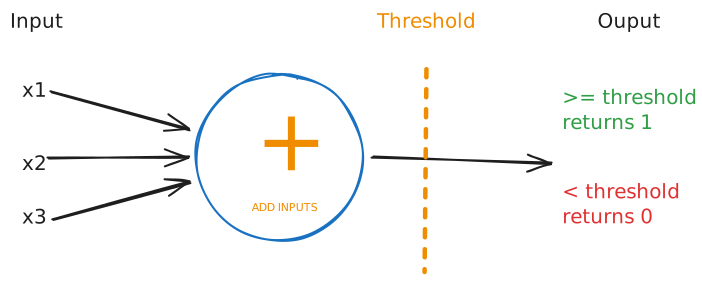
The humble neuron showing a logic operation - Image 01
What do you think this is? Yes, you are right this is the logical AND operation. The trick is in the threshold and in the check.
But there is a problem: The neuron couldn’t learn. A human had to choose the threshold. Everything was hand-crafted (sum and activation). That eventually led to the next big idea: learning from data.
But before we go there, let’s make this personal.
A Human Analogy: Decision Making in a Room Full of People #
Imagine you walk into a room where 10 people are waiting to advise you:
- 🧑🤝🧑 3 family members
- 👭 2 close friends
- 🔬 5 AI experts
You ask a simple but important question:
You automatically process these opinions differently. #
Even before you consciously think:
- Family members know your responsibilities, so their words hit deeper.
- Friends know your personality, so they speak your language.
- Experts know the technical reality, so they talk with confidence.
Each person’s voice carries a different influence on your mind.
When family speaks, you may think:
“They know me best.”
→ So their voice feels heavier.
When friends speak, you think:
“They get my vibe but not always the details.”
→ Their voice has moderate influence.
When an expert speaks, you think:
“Hmm… experts talk logically, but do they know my life?”
→ Sometimes their voice stabilizes you, sometimes it scares you 😜
→ So their influence could even be negative — meaning their YES pushes you toward NO.
Let’s say
“Even before anyone talks, YES.” - This is your bias (your prejudice)
This emotional vetting is exactly what neural networks do mathematically.
Enter Weights and Biases #
In your real life: (weights)
- Some opinions count more
- Some count less
- Some count negatively
Your prejudice (bias)
- Your bias value shifts the final decision point, just like the threshold in an MCP neuron.
In modern AI:
- Inputs are multiplied by weights
- A bias shifts the decision point (threshold)
- Learning = adjusting weights and bias based on mistakes
A machine does the same thing — just with numbers.
Why This Matters #
Once you understand this:
- You understand how AI represents decisions
- You understand how AI starts simple and becomes powerful
- You see why learning is possible — weights change
- You see why early neurons didn’t learn — weights were fixed
This foundation will help you make sense of everything that comes next: perceptrons, activation functions, deep learning, transformers — all of them build on this idea.
Mapping Human Intuition to Neural Network Concepts #
🏋️♂️ Let’s Put Numbers to Your Room #
Because this is where the magic clicks.
Let’s say you (the “neuron”) respond like this:
-
Family influence = 2
(heavy impact) -
Friends influence = 1
(moderate impact) -
Experts influence = –1
(their opinions sometimes drag your decision backward 😆)
You decide to keep your bias = 3, which represents:
“Even before anyone talks, I’m already slightly leaning toward YES.”
(Your personal push toward growth, curiosity, ambition.)
| Human Scenario | AI Concept |
|---|---|
| PEOPLE OPINION | |
| - Each person’s opinion | Inputs (F, R, E) F -> Family R -> Friends E -> Experts |
| - Possible values | Yes / No (0 or 1) |
| YOUR TRUST | |
| - How much you trust them (influence) | Weight (W) Family -> wf = 2, Friends -> wr = 1, Experts -> we = -1 |
| YOUR BIAS | |
| - Your natural tendency even before listening | Bias (b) b = 3 “Even before anyone talks, I’m already slightly leaning toward YES.” |
| - The rule you use to decide “yes/no” | Threshold (t) t = 4 |
| Final decision | Output (f) |
🧮 **Let’s look at the computation : #
Calculation #
Formula: y = wf · F + wr · R + we · E + b
Table #
| Family (F) | Friends (R) | Experts (E) | Calculation | Final Value | ≥ Threshold? | Output |
|---|---|---|---|---|---|---|
| F | R | E | wf · F + wfr · R + we · E + b | f | f ≥ t | 0 or 1 |
| 0 | 0 | 0 | (2×0) + (1×0) + (-1×0) + 3 | 3 | 3 ≥ 4? ❌ | 0 |
| 0 | 0 | 1 | (2×0) + (1×0) + (-1×1) + 3 | 2 | 2 ≥ 4? ❌ | 0 |
| 0 | 1 | 0 | (2×0) + (1×1) + (–1×0) + 3 | 4 | 4 ≥ 4? ✔️ | 1 |
| 0 | 1 | 1 | (2×0) + (1×1) + (–1×1) + 3 | 3 | 3 ≥ 4? ❌ | 0 |
| 1 | 0 | 0 | (2×1) + (1×0) + (–1×0) + 3 | 5 | 5 ≥ 4? ✔️ | 1 |
| 1 | 0 | 1 | (2×1) + (1×0) + (–1×1) + 3 | 4 | 4 ≥ 4? ✔️ | 1 |
| 1 | 1 | 0 | (2×1) + (1×1) + (–1×0) + 3 | 6 | 6 ≥ 4? ✔️ | 1 |
| 1 | 1 | 1 | (2×1) + (1×1) + (–1×1) + 3 | 5 | 5 ≥ 4? ✔️ | 1 |
What this shows (beautiful teaching moment) #
- Even one friend’s encouragement (0,1,0) can push you to YES
- Expert disapproval (E=1) lowers the total
- Family influence (F=1) is the strongest because its weight is 2
- Bias (3) shifts everything upward
- Threshold forces a clear YES/NO decision
This is literally how a McCulloch–Pitts neuron works.
inputs → weighted sum + bias → activation (threshold check) → output #
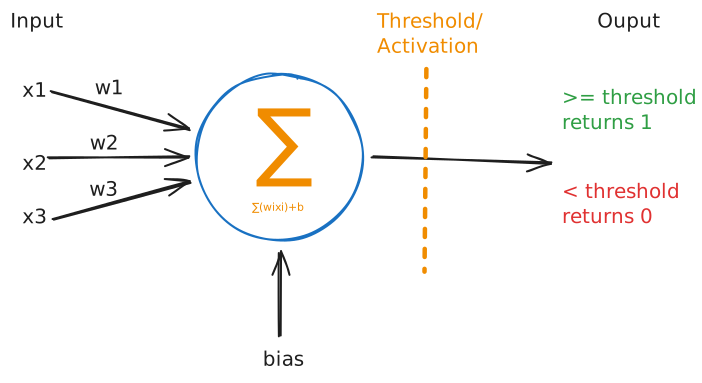
The humble neuron showing a more complex operation - Image 02
What Comes Next? #
In the next post, we’ll move from:
“A neuron that cannot learn” → “A neuron that learns from data.”
That neuron is called the Perceptron, and it’s the next major step in the history of AI.
A Final Note About the “Uninitiated” #
If you’re wondering about the word uninitiated, here’s what I mean:
Someone who has not yet been introduced to a subject —
but is ready and curious to begin.
This series is my way of holding the door open for you.
This discussion is part of AI For Unitiated